Introduction
China’s domestic kitchenware market reached 85.6‑billion‑yuan market scale during the first half of 2026, achieving 12.3‑percent year‑on‑year growth, according to AVC (All View Cloud) industry‑wide monitoring statistics. The whole cookware sector has stepped into a value‑upgrading cycle marked by premium‑oriented material innovation, intelligent‑function iteration and segmented‑scenario product research‑and‑development. The market pattern witnesses obvious divergence: well‑established domestic household‑appliance giants maintain dominant sales volume, rising specialized cookware brands seize high‑end market share, while international premium brands confront localized‑adaptation bottlenecks.
This paper presents the complete top‑20 sales ranking of kitchenware brands for H1‑2026, explores primary growth‑boosting factors for each representative enterprise, releases sales‑volume rankings for five core segmented kitchen‑goods categories, and concludes major market‑shaping tendencies and competitive risks for the second half of 2026. In this research scope, kitchenware covers metal pots and pans, silicone cooking utensils, small‑sized kitchen electrical appliances, baking supplies, tableware and multi‑functional kitchen gadgets.
1. H1‑2026 Kitchen‑Ware Full‑scale Sales Top‑20 Brand Ranking and Growth‑Cause Analysis
Sorted by combined online‑and‑offline retail sales volume, the top‑20 brand list and their respective sales‑increase incentives are broken‑down as below:
- Midea (Year‑on‑year sales growth +13.7%). As the leading comprehensive home‑appliance conglomerate, Midea benefits from mature multi‑channel layouts covering e‑commerce flagship stores, offline supermarket shelves and live‑stream sales channels. Its air‑fryer, electric‑steamer and intelligent rice‑cooker product lines realize material upgrades such as steam‑assisted baking and food‑safe inner‑pot coatings. The enterprise releases budget‑friendly entry‑level goods and mid‑to‑high‑end intelligent‑cookware series at the same time, covering consumer groups from student renters to high‑end family kitchens.
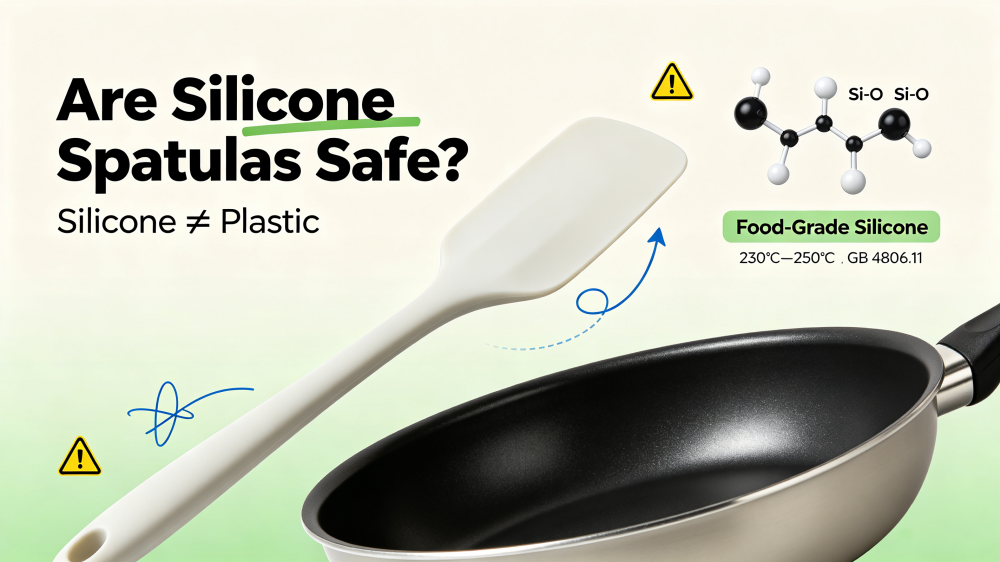
- SUPOR (+16.2%). SUPOR claims first‑place market share within traditional manual cookware. Its newly‑built intelligent cookware manufacturing base commenced operation in Q2‑2026, launching titanium‑alloy frying pans and temperature‑controlled multi‑function pot sets. Deep penetration in county‑level market supermarkets and cooperative community‑group‑buy platforms fuel rapid sales expansion; its silicone‑shovel kitchen‑tool series strictly follows GB 4806.11‑2016 food‑contact safety standards and earns outstanding consumer word‑of‑mouth.
- Joyoung (+8.4%). Joyoung concentrates on healthy small‑scale kitchen appliances. Its electric‑steamer and soymilk‑maker product groups maintain stable basic sales volume. This brand executes obvious high‑end‑pricing transformation, and the average selling‑price of flagship electric steamers rises 29.44 percent year‑on‑year. Slower‑than‑expected air‑fryer sales expansion pulls down its overall growth rate compared with SUPOR and Midea.
- ASD (Aishida) (+14.9%). ASD speeds‑up layout over short‑video live‑streaming and local‑life retail channels. Its budget‑priced starter cookware kits, bundled with frying pans, silicone spatulas and storage racks, are supplied for group‑buy platforms across 284 prefecture‑level cities. Crystal‑diamond non‑stick coating technology improves product service life and consumer re‑purchase rate to 38.6 percent, well above the industrial average value of 22.1 percent.
- Fotile (+11.3%). Fotile focuses on built‑in high‑end kitchen‑electric equipment including embedded dishwashers, range‑hoods and integrated‑stove hardware. The second‑quarter local government home‑appliance‑renewal subsidies drive dishwasher sales to shift from negative‑growth status to 11‑percent retail‑volume growth. Scenario‑based whole‑kitchen customized packages become its major competitive advantage.
- Robam (+9.6%). Similar to Fotile, Robam sticks to mid‑to‑high‑end embedded kitchen‑appliance markets. It launches low‑profile, space‑saving cooker hoods designed for compact urban apartments and wins young‑generation urban‑resident consumers.
- Bear (+18.1%). Bear ranks as the fastest‑growing mainstream brand. It specializes in mini‑sized, scenario‑oriented small kitchen appliances for single‑person renters, office workers and infant‑complementary‑food production. Compact electric hot pots, multi‑function breakfast machines and small‑capacity silicone bake‑ware achieve explosive sales growth on TikTok‑style domestic short‑video shopping platforms.
- Westinghouse (+23.5%). Westinghouse accomplishes impressive growth in premium small‑kitchen‑appliance segmentation. Its upgraded air‑fryer average selling‑price surges 38.19 percent year‑on‑year. It targets high‑income consumers who pursue PFOA‑free non‑stick material, platinum‑cured food‑grade silicone accessories and professional‑grade cooking functions.
- Philips (+10.8%). The multinational home‑goods brand gains 1.9‑percent market‑share improvement inside air‑fryer and household‑coffee‑maker markets. Nevertheless, rigid international product specifications and slow‑speed localized‑product iteration limit its overall growth ceiling.
- Zwilling J.A. Henckels (+4.2%). The German premium cookware enterprise encounters well‑known localization‑adaptation pressure. Its thick‑imported iron pots are not perfectly suited for high‑heat Chinese‑style stir‑frying. Only kitchen‑knife sets and professional baking‑tool goods maintain stable high‑end sales volume; most cast‑iron enamel cookware still relies on overseas imports and bears high logistics‑cost burdens.
- Mijia (Xiaomi) (+15.3%)
- De'Longhi (+6.7%)
- Buydeem (+20.4%)
- Carote (+17.6%)
- HexClad (+12.8%)
- LOCK&LOCK (+7.1%)
- OXO (+11.5%)
- KitchenAid (+9.3%)
- T‑fal (+8.8%)
- Royalstar (+13.2%)
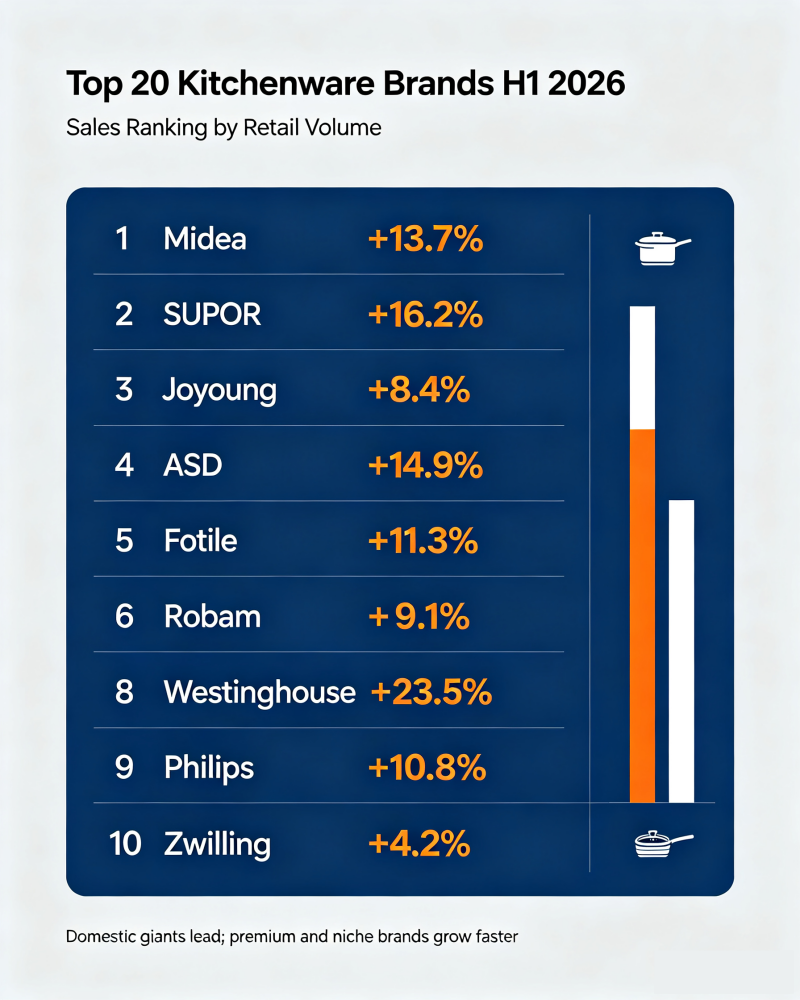
Emerging specialized cookware brands such as Buydeem and Carote achieve fast‑speed expansion. Buydeem targets high‑end slow‑cooking and home‑baking crowds. Overseas popular direct‑to‑consumer cookware brand Carote takes advantage of clean ceramic non‑stick coating technology and spreads its influence across cross‑border e‑commerce and domestic online shopping channels. Xiaomi‑owned Mijia depends on cost‑effective standardized smart‑kitchen‑hardware and complete ecological linkage with smart‑home equipment to attract tech‑savvy young buyers.
Three primary reasons are summarized for brand‑performance divergence. First, brands accomplishing material upgrading toward titanium alloy, food‑safe liquid silicone and ceramic non‑stick coating gain faster sales growth. Second, enterprises embracing short‑video live‑stream commerce and community group‑buy unlock incremental consumer markets within low‑tier cities. Third, brands that develop scenario‑targeted goods (baby complementary‑food cookware, one‑person‑use mini‑kitchen appliances, professional baking kits) outperform those selling generic, one‑size‑fits‑all cookware. International premium‑brands suffer growth constraints from poor adaptation for Chinese‑style cooking customs and sluggish localized‑product development.
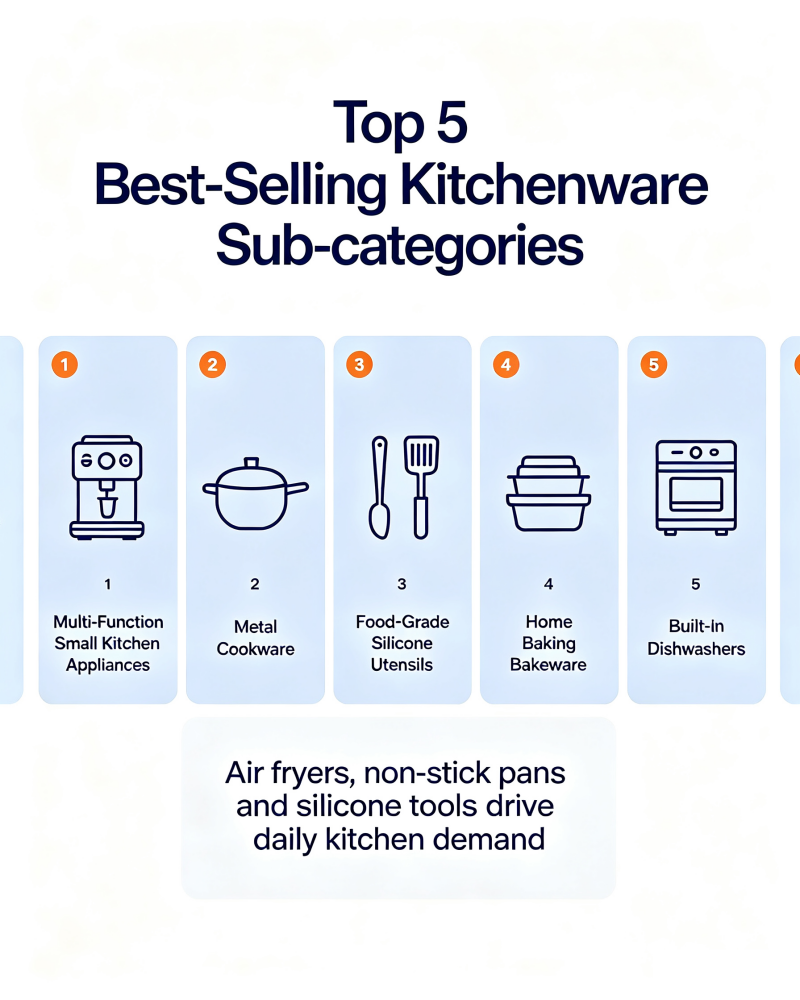
2. Top‑5 Highest‑selling Kitchen‑Ware Sub‑categories (H1‑2026)
Based on AVC segmented‑category retail‑volume statistics, the five dominant kitchen‑goods sectors are sorted below, together with their market characteristics:
No.1 Multi‑functional Small‑sized Kitchen Electrical Appliances
This category includes air‑fryers, electric steamers, multi‑purpose electric hot pots. The top‑three brands Midea, SUPOR and Joyoung occupy a combined 63.46‑percent air‑fryer market share. High‑end air‑fryers equipped with steam‑humidifying‑roast technology become the major selling hotspot, and the category average selling‑price climbs 6.84 percent year‑on‑year. Urban young renters and home‑cooking hobbyists constitute the core‑consumer base.
No.2 Manual Metal‑material Cookware (Frying‑pans, Stockpots, Pressure‑cookers)
Titanium‑coated frying‑pans and one‑click‑opening pressure cookers drive market upgrading. Ordinary coated non‑stick‑pan sales shrink, while high‑end titanium and three‑layer composite‑metal cookware witness continuous‑price increases. ASD and SUPOR lead the traditional cookware competition, and pressure‑cookers represent the fastest‑growing branch inside metal cookware thanks to convenient multi‑gear pressure‑adjustment functions.
No.3 Food‑grade Silicone Kitchen Utensils
Silicone spatulas, baking molds, heat‑resistant pot grips and silicone food scrapers enjoy booming demand. Consumer‑safety awareness against inferior industrial recycled silicone and VOC (volatile‑organic‑compound) over‑standard goods reshapes the industry competition landscape. Brands supplying platinum‑vulcanized liquid silicone kitchen‑tools and complete national‑standard labelling gain better consumer‑trust and sales performance.
No.4 Home‑baking Bakeware
Silicone cake molds, carbon‑steel baking sheets, enamel baking trays fuel the home‑baking hobby economy. Buydeem, KitchenAid and Carote occupy major high‑end market shares, while affordable domestic silicone‑mold factories dominate the low‑and‑mid‑range market. PFOA‑free, non‑toxic and high‑temperature‑resistant material acts as the decisive selling point.
No.5 Built‑in Dishwasher and Integrated‑kitchen Appliance
Dishwasher sales reversed from Q1‑negative‑growth to double‑digit volume‑increase in Q2‑2026, boosted by local government household‑appliance‑renewal incentives. Compact countertop‑type and drawer‑style dishwashers achieve faster‑than‑embedded‑type sales growth, catering to small‑sized Chinese urban‑kitchen layouts.
3. Overall Market Summary of H1‑2026 Kitchenware Industry
The first‑half‑2026 kitchenware market fully demonstrates the value‑upgrade transition from low‑price‑oriented volume expansion to material‑innovation‑driven profit growth, with three defining industrial tendencies.
To start with, material iteration becomes the core‑driving factor of brand‑competitive‑edge. Titanium‑alloy metal cookware, platinum‑cured food‑safe liquid silicone utensils and chemical‑free ceramic non‑stick pans win consumer preference, while inferior recycled‑raw‑material cookware gradually gets eliminated by increasingly‑safety‑conscious buyers. The Jiangxi Consumer Committee’s 2026 sampling inspection over silicone kitchen‑spatulas still discovers excessive volatile‑organic‑compound hazards, pushing formal brands to tighten raw‑material screening procedures.
Second, consumer‑demand segmentation reshapes product‑development directions. Single‑person mini‑kitchen‑appliances, infant complementary‑food cookware, compact‑size dishwasher equipment and home‑baking supplies create independent fast‑growing niche markets. Generic multi‑purpose pots and pans enter saturated competition and can only obtain profit‑margin improvement through high‑end material upgrading.
Third, channel structure reconstruction accelerates brand‑stratification. Traditional supermarket channels secure sales for established domestic giants SUPOR and ASD. Short‑video live‑stream shopping and community group‑buying offer low‑cost traffic for emerging specialized cookware labels. Imported overseas premium‑brands face tough‑going market expansion as a result of insufficient localized‑product‑design against Chinese‑style stir‑frying‑kitchen scenarios.
For the second half of 2026, kitchen‑ware enterprises need to prioritize safe raw‑material quality control, develop scene‑customized new‑products and deploy multi‑layer online‑and‑offline sales channels. Brands that ignore food‑contact safety standards and compete merely with low‑priced inferior goods will gradually lose market share amid ongoing industrial upgrading.