1. Why Food-Contact Certification Matters for Kitchenware
Every pan, spatula, baking sheet, and food-storage container that touches food is legally classified as a Food Contact Material (FCM). Under both U.S. and EU law, FCMs are treated as potential indirect food additives: any substance that migrates from the material into food becomes part of what consumers ingest. For kitchenware exporters, this means certification is not a marketing luxury — it is a mandatory market-access requirement. Non-compliant shipments face customs detention, platform delisting (Amazon, eBay, Temu), and mandatory recalls. In August 2025, the U.S. FDA warned that certain imported aluminum-alloy cookware could leach lead, underscoring how seriously regulators treat FCM safety.
2. FDA — U.S. Food and Drug Administration
| Item | Detail |
|---|---|
| Full Name | U.S. Food and Drug Administration |
| Governing Law | Federal Food, Drug, and Cosmetic Act (FD&C Act); Code of Federal Regulations Title 21, Parts 170–199 (21 CFR) |
| Mark/Logo | No official FDA "seal" for FCMs. Compliant products are typically labeled "FDA Compliant" or "Food Safe" with a Declaration of Compliance on file. |
| Core Meaning | The FDA regulates FCMs as indirect food additives. Every substance in a food-contact article must either be (a) listed as approved in 21 CFR, (b) the subject of an effective Food Contact Notification (FCN), or (c) Generally Recognized As Safe (GRAS). Compliance is substance-by-substance, not a single product "certification." |
| Applicable Products | All materials intended to contact food: cookware (pots, pans, baking dishes), utensils, cutlery, food packaging, storage containers, kitchen appliances with food-contact surfaces, and coatings/linings. |
| Key Tests | Extractables/leachables testing per 21 CFR Part 177 (polymers), overall migration, heavy-metal analysis (lead, cadmium), and melamine/formaldehyde release for melamine tableware. |
Practical Note for Exporters: The FDA does not "certify" products itself. Manufacturers or importers must maintain a Declaration of Compliance (DoC) and supporting test data from an accredited third-party lab (e.g., SGS, Intertek, TÜV). U.S. Customs and Border Protection may request this documentation at entry.
3. LFGB — German Food, Commodities and Feed Code
| Item | Detail |
|---|---|
| Full Name | Lebensmittel-, Bedarfsgegenstände- und Futtermittelgesetzbuch (Food, Commodities and Feed Code) |
| Governing Law | LFGB § 30, § 31, § 33 (formerly LMBG, replaced in 2005) |
| Mark/Logo | The knife-and-fork symbol (Messer und Gabel) is widely used on LFGB-compliant products, often accompanied by the text "LFGB" or "Lebensmittelecht." |
| Core Meaning | LFGB is Germany's national food-safety framework and is often considered stricter than the FDA. It prohibits placing on the market any food-contact article that, under normal or foreseeable use, could harm health or lead to an unacceptable change in the composition, odor, or taste of food. Critically, LFGB requires a sensory test — the material must not transfer any taste or odor to food — a requirement not mandated under basic FDA compliance. |
| Applicable Products | All articles intended to come into contact with food: cookware, bakeware, cutlery, kitchen tools, food storage, packaging, and even kitchen appliances (kettles, toasters, meat grinders). Also covers cosmetics packaging. |
| Key Tests | Overall migration (OML ≤ 10 mg/dm² or 60 mg/kg), specific migration limits (SML), heavy-metal release, sensory evaluation (taste/odor), and plasticizer (phthalate) screening. |
Why LFGB Matters Beyond Germany: Although LFGB is a German national law, it is widely accepted across the EU as a robust compliance benchmark. Many EU buyers — especially retailers in Germany, Austria, and Switzerland — explicitly require LFGB test reports. Holding LFGB certification can simplify access to the broader European market.
4. EU Regulation (EC) No 1935/2004 — The European Framework
| Item | Detail |
|---|---|
| Full Name | Regulation (EC) No 1935/2004 of the European Parliament and of the Council on materials and articles intended to come into contact with food |
| Governing Law | EU Regulation 1935/2004 (directly applicable in all 27 EU member states), amended by Regulation (EU) 2019/1381 (transparency) |
| Mark/Logo | The wine-glass-and-fork symbol (Annex II) must appear on FCMs whose food-contact use is not obvious (e.g., kitchenware, tableware). It may be accompanied by the text "for food contact." |
| Core Meaning | This is the overarching EU framework for all FCMs. It establishes three core principles: (1) Inertness — materials must not transfer constituents to food in quantities that could endanger human health or cause unacceptable changes in food composition, odor, or taste; (2) Good Manufacturing Practice (GMP); (3) Traceability and Declaration of Compliance (DoC) at all stages of the supply chain. It covers 17 material categories, including plastics, ceramics, metals, glass, paper, and bamboo. |
| Applicable Products | All materials and articles intended to come into contact with food, including cookware, tableware, food packaging, kitchen utensils, and processing equipment. |
| Key Requirements | Mandatory DoC, full supply-chain traceability, GMP compliance, and material-specific migration testing. |
4.1 EU 10/2011 — Plastics-Specific Regulation
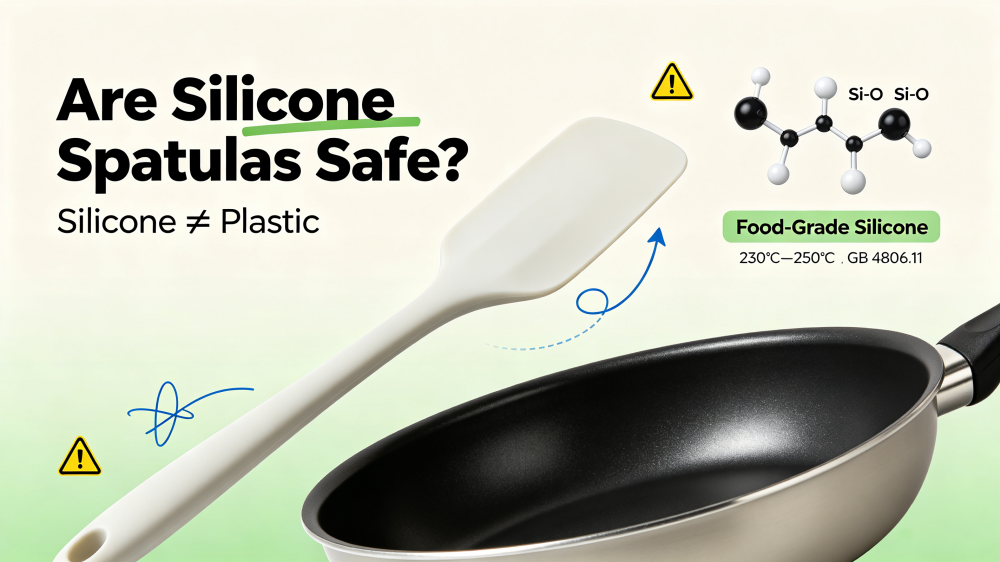
For plastic kitchenware (e.g., silicone spatulas, PP containers, melamine plates), the detailed rules are in Commission Regulation (EU) No 10/2011 (as amended). It provides:
- A positive list of authorized monomers and additives.
- Specific Migration Limits (SML) for individual substances.
- An Overall Migration Limit (OML) of 10 mg of substances per dm² of food-contact surface (or 60 mg/kg of food simulant).
- Rules on Bisphenol A (BPA) — banned in infant feeding bottles and subject to migration limits in other plastics.
5. Additional Marks and National Requirements
California Proposition 65 (U.S.)
While not a food-contact certification per se, Proposition 65 requires products sold in California to carry a warning label if they expose consumers to listed chemicals (e.g., lead, cadmium, BPA) above specified thresholds. Ceramic and metal cookware are frequently targeted. Non-compliance can result in significant penalties and private lawsuits.
DGCCRF (France)
France's Direction Générale de la Concurrence, de la Consommation et de la Répression des Fraudes (DGCCRF) enforces food-contact safety under national decree 2004-64. It has specific requirements for certain materials (e.g., stainless steel, aluminum, silicone) and is known for rigorous market surveillance.
CE Marking — Important Clarification
The CE mark is not a food-contact safety certification. CE marking applies to product categories covered by EU "New Approach" directives (e.g., electrical appliances under the Low Voltage Directive, toys). For electrical kitchen appliances (blenders, electric kettles), CE marking is required for electrical safety and EMC, but it does not demonstrate food-contact compliance — that must be proven separately under 1935/2004 and material-specific regulations.
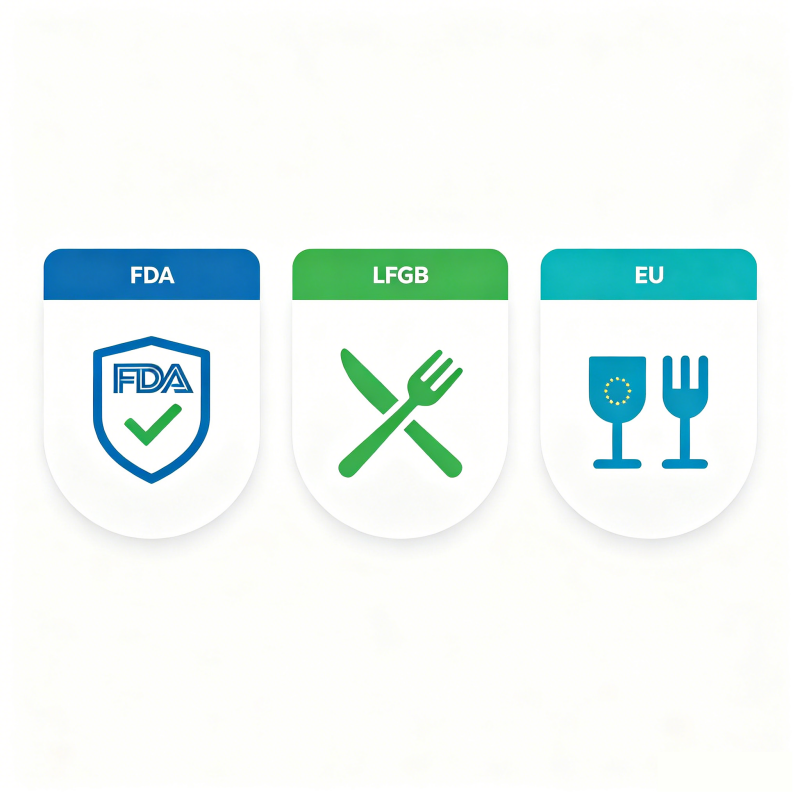
6. Comparing FDA vs. LFGB vs. EU 1935/2004
| Dimension | FDA (U.S.) | LFGB (Germany) | EU 1935/2004 |
|---|---|---|---|
| Legal Scope | Federal, U.S.-only | National, Germany | EU-wide, 27 member states |
| Approach | Substance-by-substance approval (21 CFR positive lists + FCN + GRAS) | National safety law + sensory testing | Framework regulation + material-specific measures |
| Sensory Test | Not required | Required (taste/odor transfer) | Required (unacceptable odor/taste change prohibited) |
| Key Document | DoC + test reports | LFGB test report (often with knife-and-fork mark) | DoC + traceability records |
| Migration Limits | Material-specific extractables limits | OML 10 mg/dm²; SML per substance | OML 10 mg/dm²; SML per substance (EU 10/2011 for plastics) |
| Common Products | All FCMs | All FCMs (especially cookware/tableware) | All FCMs |
7. Practical Steps for Kitchenware Exporters
- Identify target markets — U.S. requires FDA compliance; EU requires 1935/2004 + material-specific rules; Germany often adds LFGB.
- Bill of Materials (BOM) review — Map every material that touches food (coating, substrate, adhesive, gasket). Each must be compliant.
- Select an accredited lab — ISO 17025-certified labs (SGS, TÜV Rheinland, Intertek, Bureau Veritas) issue internationally recognized reports.
- Conduct migration testing — Use appropriate food simulants (water, 3% acetic acid, 10% ethanol, olive oil/vegetable oil) based on the food type the product will contact.
- Compile the Declaration of Compliance (DoC) — Required for both U.S. and EU entry; must list applicable regulations, test results, and responsible operator.
- Apply correct labeling — EU: wine-glass-and-fork symbol + "for food contact" where needed; LFGB: knife-and-fork mark; U.S.: "FDA Compliant" / "Food Safe" (avoid implying FDA endorsement).
- Maintain traceability — Keep batch records, supplier declarations, and test reports for at least the product's shelf life plus several years.
8. Conclusion
Food-contact certification is the foundation of kitchenware international trade. The FDA framework governs U.S. market access through 21 CFR substance approvals; LFGB sets Germany's stricter national standard, including mandatory sensory testing; and EU Regulation 1935/2004 provides the harmonized European framework, supported by material-specific rules like EU 10/2011 for plastics. Understanding the marks — the FDA-compliant label, the LFGB knife-and-fork, and the EU wine-glass-and-fork — and pairing them with rigorous migration testing and a valid Declaration of Compliance is the surest way to clear customs, satisfy retail buyers, and protect consumers. For exporters, investing in accredited testing upfront is far less costly than a shipment held at port or a product recalled from shelves.