Introduction
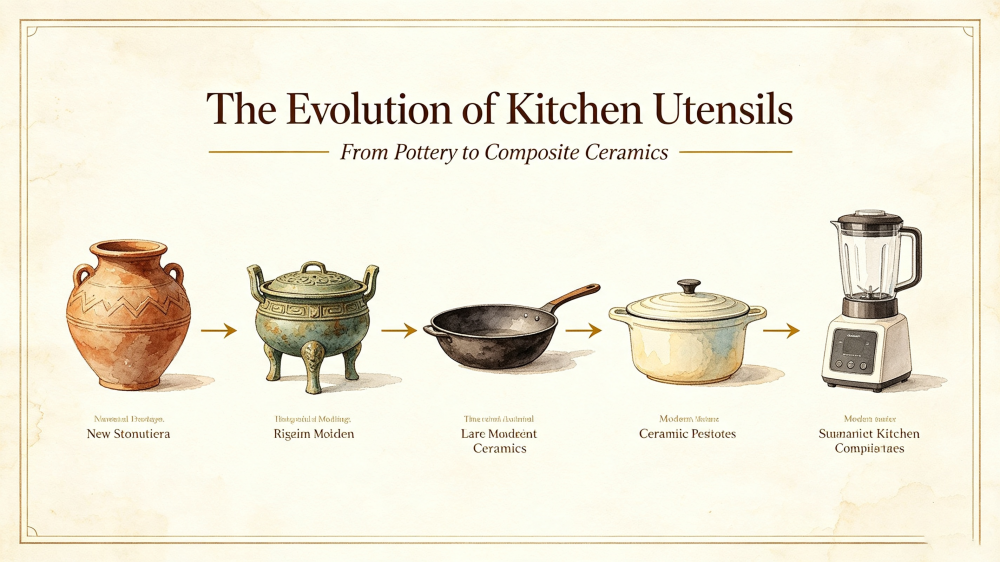
A complete, flavorful home-cooked meal relies entirely on functional kitchen utensils, yet the cooking tools humans take for granted today underwent a millennia-long iterative revolution in China. Ten thousand years ago, open bonfires served as primitive kitchens without dedicated containers; as craftsmanship, metallurgy and ceramic firing technology advanced, kitchen utensils evolved from rough clay pots to delicate bronze ritual vessels, durable iron woks, mass-produced porcelain tableware, and modern intelligent germanium ceramic electric pressure cookers. Every shift in cookware material mirrors the progress of productivity, cooking culture and living standards. Based on the historical division of Chinese kitchen utensil development, this paper reviews each historical stage’s mainstream cookware materials, compares their strengths and weaknesses, and identifies the material category that will sustain long-term development alongside supporting reasoning.
1. Stage-by-stage Evolution of Chinese Kitchen Utensils and Core Materials
1.1 Neolithic Age: Pottery as the Original Cooking Carrier
Around 10,000 years ago, pottery emerged as China’s first artificial cooking container. Ancient residents shaped clay into tripods, pots and steamers before firing them at low temperatures, creating the earliest cookware for boiling, stewing and steaming. Before pottery invention, primitive humans only roasted food over open flames, lacking tools for liquid cooking such as soup and porridge. Clay pottery featured abundant raw materials and simple production processes, accessible to all clans regardless of social status. However, its obvious drawbacks included fragility, poor thermal conductivity and easy water seepage, restricting cooking efficiency and service life. Pottery laid the foundational logic of cookware—creating sealed containers to heat food with water vapor, a core cooking principle still adopted by modern steam cookers.
1.2 Xia, Shang and Zhou Dynasties: Bronze Cookware Exclusive to Nobility
Metallurgy breakthroughs in slave society ushered in the bronze cookware era. Bronze tripods, cauldrons and steamers replaced partial pottery for elite families; bronze delivered superior thermal conductivity and structural rigidity, enabling uniform heating and richer cooking techniques. Bronze vessels also functioned as ritual instruments for sacrificial ceremonies, symbolizing power and hierarchy. Critical limitations blocked universal popularity: copper ore resources were scarce, smelting required massive labor and fuel, and bronze production costs remained unaffordable for common civilians. Ordinary households still relied on clay pottery throughout this period, making bronze a class-divided cookware material rather than a universal daily tool.
1.3 Han to Sui-Tang Dynasties: Iron Cookware Gradually Replaces Bronze
Iron smelting technology matured after the Han Dynasty, pushing iron cookware into mainstream civilian kitchens. Iron pots, iron cauldrons and iron frying pans solved bronze’s cost bottleneck: iron ore reserves were widely distributed across China, and iron casting simplified mass manufacturing. Meanwhile, sand pot-style coarse ceramics coexisted with ironware for slow stewing dishes. Iron’s outstanding thermal conductivity supported stir-frying, a signature Chinese cooking method that flourished in the Tang Dynasty. Defects of early iron cookware included easy rusting and heavy weight, yet its low production cost and strong durability made it the primary cooking vessel material for over a thousand years.
1.4 Sui, Tang, Song and Yuan Dynasties: Diversified Composite Cookware System
Tang and Song dynasties represented a golden age of culinary culture, driving diversified material innovation in kitchen utensils. Six-grid multi-layer steamers, exquisite bronze hot pots and double-eared iron woks appeared, matching the booming stir-fry, hot pot and multi-course banquet culture. Porcelain firing technology advanced sharply during this phase: high-temperature glazed porcelain reduced water absorption, turning porcelain into ideal tableware for serving finished dishes while iron retained its position as core heating cookware. This era formed a clear material division: iron for high-temperature cooking, bronze for luxury catering, porcelain for table setting and coarse pottery for slow stewing.
1.5 Ming and Qing Dynasties: Porcelain Dominates Daily Tableware
Porcelain craftsmanship reached its peak in Ming and Qing dynasties. Jingdezhen and other kilns realized large-scale standardized porcelain production with stable glaze texture, exquisite painting and affordable prices. Porcelain fully replaced rough pottery for household bowls, plates and dishes, and Chinese porcelain cookware was exported worldwide via maritime trade routes. Though porcelain excelled as tableware, its low thermal shock resistance meant it could not bear direct open-flame heating, restricting its function to serving rather than cooking. Iron woks still occupied the core cooking position in every family kitchen during this period.
1.6 Early Modern Times: Coal-fired Iron Kitchen as Standard Household Configuration
After the Industrial Revolution’s influence spread to China, coal replaced firewood as mainstream fuel, and cast iron coal stoves and large iron woks became universal kitchen equipment. Independent enclosed kitchens gradually formed, yet various iron cookware, wooden cutting boards and clay containers piled randomly on countertops with unified aesthetic design absent. Iron remained the irreplaceable cooking material, while porcelain stayed the main tableware material; new metal materials such as aluminum emerged but failed to gain mass acceptance due to early health concerns and unstable processing technology.
1.7 Contemporary Era: Multi-material Intelligent Kitchenware & Germanium Ceramic Innovation
Modern technological progress brought explosive diversification of cookware materials: stainless steel, aluminum alloy, non-stick coated metal, high-temperature ceramic and germanium ceramic composite cookware entered ordinary families. Pressure cookers, flat frying pans, electric stew pots and integrated kitchen appliances reshaped cooking modes. Among innovative products, germanium ceramic electric soup cookers applied water-isolated steaming: steam heats the germanium-containing ceramic inner liner, which releases far-infrared radiation to lock food nutrition and original flavor. This composite ceramic material combines the food safety of traditional porcelain with optimized thermal performance, solving porcelain’s inability to withstand direct heating and iron’s rusting and heavyweight flaws. Integrated modern kitchens prioritize humanized design, balancing material safety, heating efficiency and appearance aesthetics.
2. Comparative Analysis of Core Cookware Materials’ Advantages and Defects
To judge which material sustains long-term development, we compare five historical mainstream cookware materials from raw material reserve, production cost, food safety, thermal performance and service life dimensions:
- Pottery: Abundant raw materials, low cost, but fragile, poor heat conduction, prone to seepage; only used for partial stew containers now, limited development space.
- Bronze: Excellent thermal conductivity, high texture, scarce ore, extremely high cost, historically exclusive to nobility; cannot realize universal civilian promotion, limited industrial expansion potential.
- Cast iron: Good thermal conductivity, low ore cost, easy rusting, heavy weight, prone to metal ion precipitation under long-term acid cooking; partial functional defects cannot be fully eliminated via craft improvement.
- Porcelain (traditional glazed ceramic): Safe contact with food, smooth surface, easy cleaning, abundant clay raw materials, mass-producible; weak thermal shock resistance, cannot bear direct open flame heating, only suitable for tableware.
- Germanium-containing composite ceramic (modern upgraded ceramic): Inherits porcelain’s food safety and easy-clean merits; optimized firing formula improves thermal shock resistance to support indirect and partial direct heating; added germanium elements enhance nutrition-locking cooking performance; raw mineral resources are sustainable, firing technology continuously iterates to reduce cost, matching modern consumers’ pursuit of healthy, low-oil, original-flavor cooking.
3. Composite Ceramic Material Will Maintain the Longest Sustainable Development
After comparing all material categories, ceramic-based composite materials represented by germanium ceramic will become the cookware material with the longest sustainable development, supported by four core reasons:
First, unparalleled food safety advantages. Ceramic forms stable inorganic glaze after high-temperature firing, no harmful heavy metal precipitation under high-temperature or acidic food contact, unlike metal cookware that risks rust, coating peeling or metal ion dissolution. As public health awareness rises, non-toxic, inert food-contact materials become rigid consumer demand, creating long-term market demand for ceramic cookware.
Second, sustainable and abundant raw material supply. The primary raw material of ceramic is clay, widely distributed domestically and globally with renewable and recoverable reserves, free from the resource depletion risks of metal ores such as iron and copper. Ceramic production relies on mineral soil rather than limited metal mineral deposits, ensuring stable raw material supply for thousands of years.
Third, unlimited technical upgrade space. Traditional porcelain’s thermal defect can be solved via formula modification, composite mineral doping (germanium, lithium, silicon) and multi-layer glaze technology. Manufacturers can continuously optimize thermal conductivity, thermal shock resistance and functional attributes (far-infrared heating, antibacterial glaze) without changing the core ceramic substrate. From ancient clay pottery to Ming-Qing porcelain and modern germanium composite ceramics, ceramic materials show continuous iterative upgrade capacity absent in single metal materials.
Fourth, matched with modern environmental and consumption trends. Ceramic production produces controllable industrial pollution, and waste ceramic products can be crushed and recycled for new kiln raw materials, complying with global low-carbon and circular economy policies. Contemporary consumers pursue light, healthy, original-taste cooking; germanium ceramic steam cookers fully fit this trend, while metal cookware face bottlenecks in solving rust and coating shedding.
Iron, bronze and pottery can only serve as auxiliary segmented cookware materials in the future: iron woks retain partial market share for stir-frying, bronze remains high-end collectible tableware, and coarse pottery is limited to niche slow-stew utensils. Only composite ceramic materials integrate safety, sustainability, technical scalability and consumption trend compatibility, supporting continuous, long-term industrial development.
Conclusion
Chinese kitchen utensils evolved alongside human cooking civilization, shifting from primitive clay pottery to noble bronze, mass iron cookware, universal porcelain and modern functional composite ceramics. Every material transition corresponds to breakthroughs in craftsmanship and changes in public living demands. Among all cookware materials emerging in ten thousand years of history, composite ceramic materials led by germanium ceramic possess irreplaceable strengths in food safety, raw material sustainability, technical iteration potential and market trend adaptability. In the long run, ceramic composite materials will occupy the dominant position in kitchen cookware and maintain the longest continuous development cycle, while metal and single clay materials will only retain segmented auxiliary application scenarios.