Against the global zero‑waste trend, reusable food containers have gradually replaced single‑use plastic takeaway packaging in households, offices, schools and outdoor scenarios. Among various material choices including plastic, glass and stainless steel, food‑grade silicone lunch boxes have gained explosive popularity in global consumer markets, thanks to their wide temperature tolerance, microwave compatibility, lightweight texture and eco‑friendly reusable features.
Market Background: Why Silicone Lunch Boxes Win Modern Consumers
Modern consumers hold three core demands for lunch containers: food safety, multi‑scene adaptability and environmental sustainability. Traditional PP plastic lunch boxes may produce chemical risks under repeated high‑temperature microwave heating; glass bento boxes are heavy and easy to crack during commuting; stainless steel containers cannot be used inside microwave ovens, limiting daily reheating options.
Food‑grade platinum‑cured silicone perfectly fills these pain points. Qualified silicone lunch boxes support temperature ranges from‑40°C to 230°C, safe for freezers, microwave ovens, dishwashers and short‑term oven heating, without risk of harmful substance migration under normal usage. As consumers pay more attention to reducing single‑use plastic waste, silicone food containers with multi‑year service cycles become a hot‑selling category for cross‑border export. Factories keep iterating structures: besides classic fixed‑shape silicone lunch boxes, collapsible foldable silicone lunch boxes emerge as a major selling point targeting travellers and people with limited cabinet storage space.
Core Product Introduction: Regular Silicone Lunch Box VS Collapsible Silicone Lunch Box
Regular Non‑collapsible Silicone Lunch Box
The regular silicone lunch box refers to fixed‑wall integral‑moulded silicone bento, mostly available in single‑compartment or multi‑compartment designs. The box body maintains fixed height and shape permanently, matched with PP or silicone sealing lids. Most models support divided‑plate design to separate rice, meat and vegetables and avoid flavour cross‑mixing.
Advantages come from stable physical structure. The box wall keeps rigid shape when filled with soup, sauce or heavy food. Compartment dividers will not deform under food weight, delivering reliable leak‑proof performance when paired with qualified sealing lids. For daily office lunch packing, meal prepping at home and children’s school bento use, fixed‑shape silicone lunch boxes behave stably for long‑term daily use.
Its obvious shortcoming lies in storage performance. Whether empty or full, it occupies fixed cabinet and backpack space. When you own multiple sets, stacking still takes considerable room in kitchen drawers or refrigerator shelves.
Factory‑supplied Collapsible Silicone Lunch Box
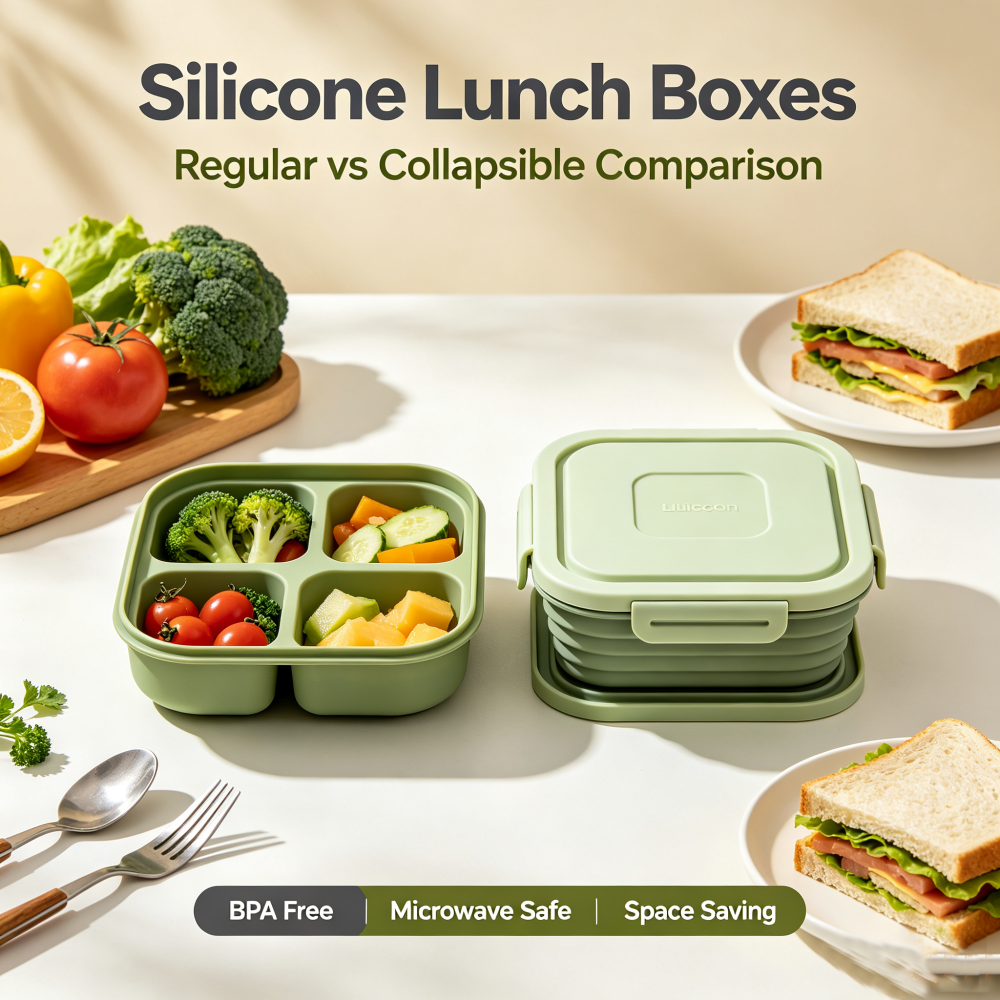
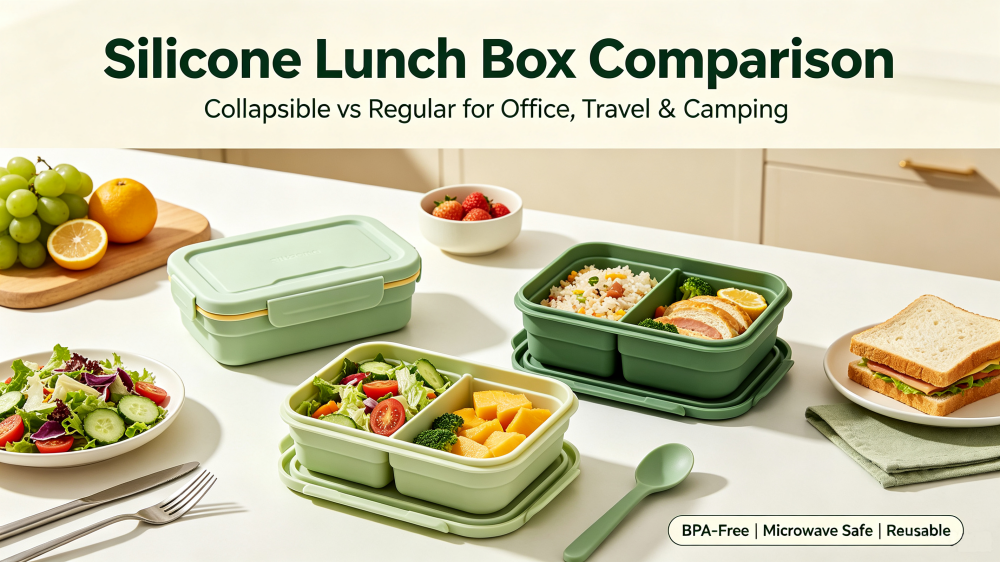
This factory’s collapsible silicone lunch box is made of 100% BPA‑free food‑grade silicone body, cooperating with snap‑lock PP transparent lids with exhaust valves. The side wall adopts foldable corrugated silicone structure. Users can compress the whole box down to about one‑third of original height when empty, greatly reducing storage volume. Available capacities cover 350ml, 540ml, 800ml up to 1200ml, covering snacks, single‑person lunch and family leftover storage needs.
The biggest highlight is space‑saving capability. After folding flat, it can be slipped into backpack side pockets, handbags or narrow kitchen cabinet gaps, which is extremely friendly for camping, hiking, business trips and small‑apartment families. It still supports microwave heating, freezer preservation and dishwasher cleaning, inheriting silicone material’s core merits.
However, structural trade‑offs exist. Foldable side walls sacrifice partial rigidity. When loaded with thin soup or heavy‑weight food, excessive squeezing on backpack may cause slight deformation of box walls and raise leakage risks. Most collapsible models cannot add built‑in compartments; multi‑flavour food separation will rely on independent inner containers. Repeated long‑term folding may produce subtle crease marks on silicone fold positions, though high‑quality platinum‑cured silicone will not crack easily under normal service life.
Comparative Analysis Table: Key Dimensions Between Two Silicone Lunch Box Types
| Evaluation Dimension | Regular Silicone Lunch Box | Collapsible Silicone Lunch Box (Factory Alibaba Product) |
|---|---|---|
| Material | Food‑grade platinum silicone; optional multi‑compartment | Food‑grade BPA‑free silicone body + PP lid, foldable side wall |
| Storage Performance | Fixed volume, large occupation | Collapses to 1/3 original height, excellent space‑saving |
| Rigidity & Anti‑deformation | High, keep shape under heavy food load | Medium; easy to deform under strong external squeezing |
| Leak‑proof Capacity | Excellent with matched sealing lid | Good for thick food; moderate risk for thin soup under extrusion |
| Compartment Option | Support multi‑compartment partition design | Mostly single‑compartment structure |
| Applicable Temperature | -40℃‑230℃, microwave / freezer / dishwasher safe | -40℃‑230℃, microwave / freezer / dishwasher safe |
| Scenarios Fit | Office daily lunch, kid school bento, home meal prep | Travel, camping, outdoor picnic, small‑space household storage |
| Factory Production Cost | Low‑medium, simple mould | Higher; special fold‑structure mould, strict folding‑resistance testing |
| Potential Defect | Bulky when empty | Crease marks after thousands‑time folding; limited compartment solutions |
Suitable Scenarios & Target User Groups
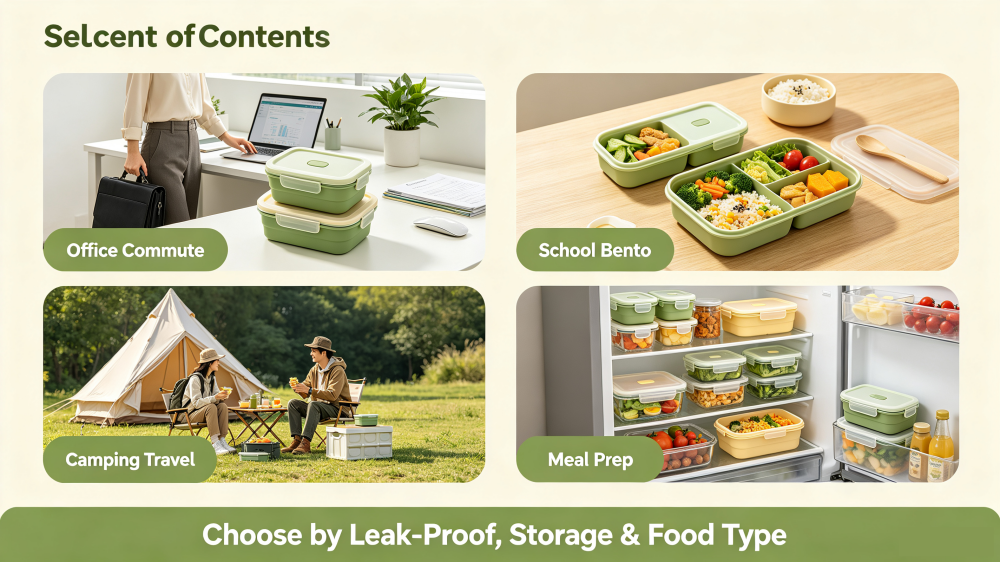
If you prepare box lunch every working day, need to pack soups, curries and liquid‑rich food, or prepare partitioned bento meals for kids, fixed‑shape silicone lunch boxes are more reliable. Stable box walls prevent compartment bending and food mixing. Reliable leak‑proof performance avoids sauce spilling inside office bags. For family meal prep users who mainly store food inside refrigerators instead of carrying outside, fixed‑shape silicone containers deliver more stable long‑term using experience.
When collapsible silicone lunch boxes bring maximum value
Collapsible silicone lunch boxes shine for outdoor enthusiasts, frequent business travellers and residents living in small‑size apartments with limited kitchen storage. After meals, users can fold empty containers flat and put them into backpacks without burden. During camping or hiking trips, multiple folded lunch boxes hardly occupy backpack volume. For consumers who seldom carry liquid‑rich thin soup and focus on dry or semi‑solid food like salads, sandwiches and fruits, collapsible silicone lunch boxes are ideal lightweight solutions.
Wholesale buyers should notice: for retail targeting office daily commuters, regular silicone bento with dividers maintains higher repurchase satisfaction; for outdoor‑focused e‑commerce stores and travel‑product retailers, this factory’s collapsible silicone lunch box has outstanding selling‑point advantages on cross‑border platforms such as Alibaba and Amazon.
Key Purchasing & Identification Tips for Factory‑Sourced Silicone Lunch Boxes
Whether selecting regular or collapsible silicone lunch boxes, material quality determines safety and service life. Many low‑cost inferior silicone products on the market add recycled fillers, which may produce peculiar odours under microwave heating and cause pigment staining.
First, check formal certifications. Qualified export‑oriented factory products should provide FDA or LFGB food‑contact test reports, confirming BPA‑free, phthalate‑free compliance. For bulk procurement, require suppliers to provide raw‑material source statements and third‑party test documents, rather than only believing product‑page propaganda words.
Second, distinguish platinum‑cured silicone from ordinary peroxide‑cured silicone. Platinum‑cured silicone has no pungent rubber odour, maintains smooth surface after repeated folding and heating, and resists oil pigment staining better. Inferior silicone will release heavy odour after first microwave heating.
Third, test structure according to usage purposes. If you need to frequently hold soup food, do not blindly pursue collapsible models. Even well‑made collapsible lunch boxes should avoid violent squeezing after filling liquids. When receiving factory samples, perform folding fatigue tests for collapsible products: fold and unfold hundreds of times to observe whether cracks or permanent hard creases occur at fold positions.
Fourth, pay attention to lid accessories. Many silicone lunch box lids adopt PP plastic, which may not be suitable for microwave heating. Remember to open the exhaust valve or remove lids during microwave reheating to avoid internal air pressure expansion and seal damage.
Daily Maintenance Suggestions to Extend Service Life
Silicone lunch boxes are dishwasher‑safe, yet proper maintenance reduces staining and odour residue. Avoid hard steel‑wool scrubbers which scratch silicone surface. For stubborn pigment stains left by tomato sauce or turmeric food, soak containers with baking‑soda water for several hours, then clean with soft sponges. Do not use silicone lunch boxes over open fire, even though silicone bears high temperature. For collapsible silicone lunch boxes, keep dry before folding for long‑time storage; avoid folding when stained with oil residue, to prevent hard‑to‑remove crease stains.
Conclusion
Neither regular nor collapsible silicone lunch boxes can be universally superior. Regular fixed‑wall silicone lunch boxes provide stable rigidity, reliable leak‑proof performance and multi‑compartment options, best for daily office, school and home meal‑prep scenarios. The factory‑produced collapsible silicone lunch box, as shown on Alibaba, achieves outstanding space‑saving benefits through foldable structure and is tailor‑made for travel, camping and small‑storage‑space households, while users need to accept partial structural limitations.
As global demand for eco‑friendly reusable food containers keeps rising, silicone lunch box manufacturers keep optimizing material formula and structural details. For individual consumers, clarify your core usage scenarios before purchasing. For wholesale buyers, match product positioning with target customer groups, and strictly verify factory‑provided safety certifications to avoid inferior‑quality inventory. Selecting the proper silicone lunch box model will bring safe, convenient and low‑carbon dining experience for daily life.