For artists, art dealers, gallery operators, and art industry practitioners, selling art online is no longer an optional supplement but a core business channel to expand customer groups, enhance brand influence, and boost sales volume. However, countless art professionals struggle with platform selection, audience positioning, and standardized online sales operations, leading to low exposure and poor conversion of high-quality artworks. This article will systematically introduce the top-tier global art sales websites suitable for different art business models and share practical industry tips.
Key Principles for Selling Art Online
Before exploring mainstream art platforms, it is essential to clarify three core principles of online art sales, which run through all platform operations and determine long-term sales performance. First, platform matching precedes operation. Different platforms have distinct audience positioning, commission rules, and artwork orientation; original fine art, digital prints, print-on-demand works, and commercial art assets require targeted platform selection. Second, professional presentation builds trust. Unlike offline art viewing, online sales rely on high-definition visuals, detailed artwork descriptions, and complete artist background information to eliminate buyers’ information gaps. Third, long-term operation beats casual posting. The online art market values artist credibility and portfolio accumulation; continuous updates and interactive operation are the keys to stabilizing collector groups.
Top 5 Best Art Websites to Sell Art Online
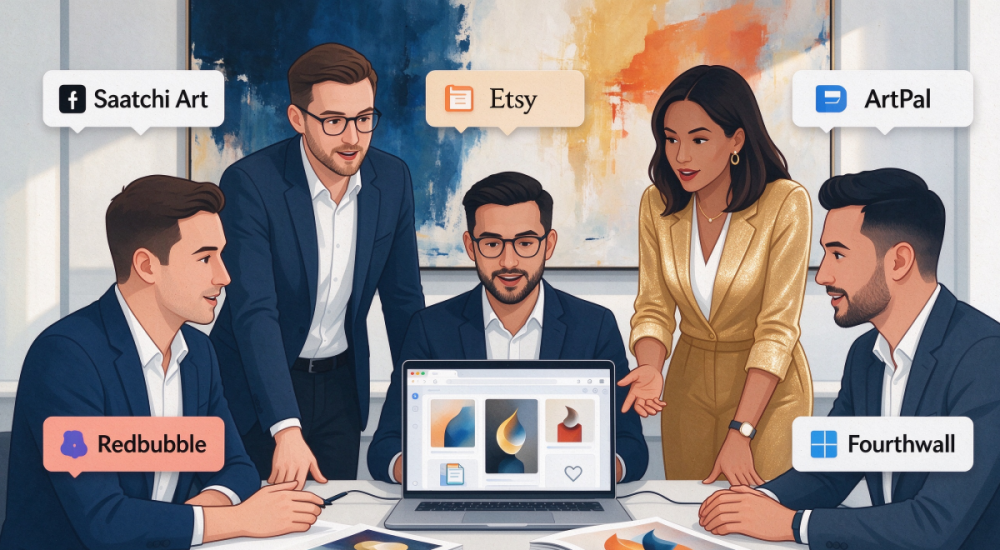
Based on global market share, user credibility, commission mechanism, audience quality, and service support for sellers, we have selected five most valuable art sales platforms for industry practitioners, covering professional fine art marketplaces, beginner-friendly platforms, zero-commission tools, and print-on-demand systems.
1. Saatchi Art – Best for Professional Original Fine Art Sales
As one of the world’s largest and most authoritative professional art marketplaces, Saatchi Art has gathered over 90,000 global creators and more than 1 million artworks, covering paintings, sculptures, mixed media, photography, and limited-edition fine art prints. It is the top choice for professional artists and high-end gallery practitioners to launch original fine art and reach global high-net-worth collectors.
Core Advantages for Sellers: The platform adopts a strict curated mechanism, which effectively filters amateur works and maintains high overall art market quality, helping professional sellers shape high-end brand positioning. It provides one-stop logistics, authentication, and after-sales support, freeing sellers from complex cross-border transaction procedures. Compared with traditional offline galleries that usually take a 50%–60% commission, Saatchi Art’s 40% commission rate is more cost-effective in the professional fine art track.
Suitable Scenarios: Selling original handcrafted artworks, high-value limited-edition art, and gallery-level fine art; expanding European and American high-end collector resources.
2. Etsy – Best for Beginners & Handmade Art Prints
Etsy is the world’s leading e-commerce platform focusing on handmade and creative products, with more than 90 million active global buyers. Different from highly professional art platforms, its users are art lovers and mid-end collectors who prefer personalized, unique, and cost-effective artworks, making it extremely friendly for emerging artists and small art studios.
Core Advantages for Sellers: The entry threshold is extremely low; sellers can complete store opening and artwork listing within hours with no strict qualification review. The platform has a built-in massive precise creative consumer group, requiring no long-term brand accumulation to obtain basic exposure. Its buyers are less price-sensitive than those on general e-commerce platforms, with stable conversion rates for small and medium-priced art prints, original sketches, and customized artworks.
Suitable Scenarios: Selling handmade original art, decorative art prints, customized art works, and printable digital art; novice practitioners building initial online sales channels.
3. ArtPal – Best for Zero-Commission Independent Sales
ArtPal is a popular independent art sales platform known for its zero commission policy, which is a rare cost-effective choice in the global art e-commerce industry. It is committed to helping independent artists and small gallery sellers retain 100% of sales revenue, with no hidden handling fees or transaction deductions.
Core Advantages for Sellers: Besides zero commission, the platform supports flexible pricing and independent order management, allowing sellers to control all transaction links independently. It connects independent artists directly with global art collectors, eliminating middleman markups. The background operation is simple, supporting portfolio management, order tracking, and customer message interaction, suitable for lightweight art sales operations.
Suitable Scenarios: Independent artists selling original works, small studios pursuing high profit margins, and practitioners testing new artwork market acceptance.
4. Redbubble – Best for Passive Income & Print-on-Demand Art
Redbubble is a top-tier print-on-demand art platform, focusing on realizing commercial monetization of digital art and creative graphics. It solves the pain points of inventory pressure, production, and logistics for art sellers, and is the best tool for artists to create long-term passive income.
Core Advantages for Sellers: Sellers only need to upload original digital artworks and patterns; the platform is responsible for all links including product production, printing, packaging, logistics, and after-sales service. It supports multiple derivative products, including art posters, canvas prints, clothing art patterns, and home decoration art, maximizing the commercial value of a single artwork. There is no entry fee and no inventory risk, achieving zero-cost secondary monetization of artworks.
Suitable Scenarios: Digital artists, illustrators, and creative designers monetizing graphic works; developing art derivative businesses and realizing passive income.
5. Fourthwall – Best for Integrated Branded Art Sales
Fourthwall is an all-in-one art sales platform that integrates original artwork sales, print-on-demand customization, digital file sales, and fan membership operations. It is specially designed for art practitioners who want to build independent brand stores and realize diversified business operations.
Core Advantages for Sellers: It supports centralized management of all art businesses on one platform, avoiding the trouble of dispersing works on multiple platforms. In addition to conventional artwork sales, it supports limited-time artwork flash sales, fan membership customization, and social platform drainage linkage, helping sellers build private domain collector groups. It balances original high-end art sales and mass derivative product sales, covering high, medium and low-end market demands.
Suitable Scenarios: Mature art studios and independent artists with personal brand awareness; practitioners who need diversified operations of original works, digital art, and art derivatives.
Practical Industry Tips to Boost Online Art Sales Conversion
Choosing a high-quality platform is the foundation, and standardized professional operation is the core to improve sales volume. Combined with the operation experience of senior art industry practitioners, we summarize four practical and efficient online sales skills.
First, optimize artwork display and copywriting professionally. Online art transactions rely on visual presentation. Sellers need to shoot high-definition, no-reflection, and multi-angle artwork photos, and simulate real hanging and display scenes to let buyers perceive the actual effect of artworks. In terms of copywriting, besides basic size, material, and creation time information, add creative concepts, artistic connotation, and creation stories to endow works with emotional value, which can significantly improve buyer willingness to pay.
Second, implement differentiated platform operation. Do not blindly publish the same content on all platforms. For high-end platforms such as Saatchi Art, focus on displaying high-quality original works and artist professional resumes to attract high-end collectors; for Etsy and Redbubble, focus on updating cost-effective decorative prints and derivative products to capture mass consumer groups; for zero-commission platforms such as ArtPal, launch preferential activities appropriately to increase order volume.
Third, accumulate private domain collector resources. Public platform traffic is unstable, while private domain fans are long-term stable customers. Actively reply to buyer comments and private messages on each platform, establish good interactive relationships, and guide high-intent buyers to follow personal social accounts or join customer groups. Regularly update new works, creation dynamics, and art exhibition information to enhance user stickiness and realize repeat purchases and customer referral.
Fourth, maintain continuous portfolio updates. The online art market favors active creators. Long-term unupdated stores will reduce platform weight and buyer trust. It is recommended to update 1–3 new works regularly every week, sort out classic portfolios, and mark limited-edition works and sold works to create a sense of scarcity, stimulating buyers’ desire for purchase.
Conclusion
Online art sales have broken the traditional art market’s monopoly and threshold, bringing unprecedented development opportunities for global art practitioners. There is no one-size-fits-all best platform; the optimal solution is to select and match platforms according to artwork positioning, business models, and development goals.
Professional fine art creators can rely on Saatchi Art to expand high-end market resources; novice practitioners can start with Etsy and ArtPal to accumulate customers and experience; digital art and derivative creators can use Redbubble and Fourthwall to realize diversified monetization. Combined with professional display, differentiated operation, and long-term private domain accumulation, art industry practitioners can steadily improve online sales performance and build sustainable online art business brands in the digital market.