1. Why Silicone Ice Mold Sourcing Is a Risk Minefield
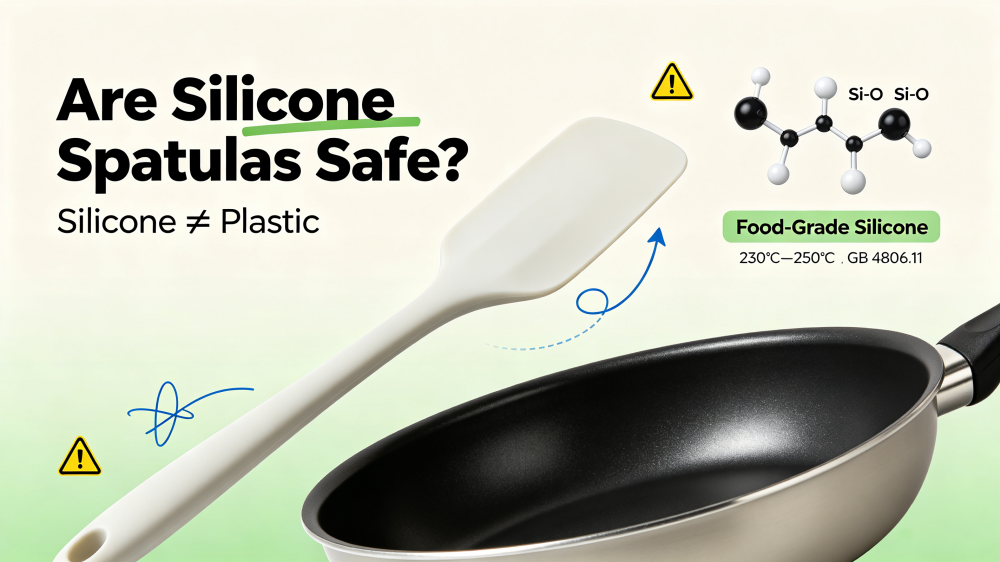
Silicone ice molds look simple — a flexible tray, a few cavities, a lid. But beneath that simplicity lies a regulatory and quality minefield. Silicone is an elastomer, not a plastic, which means it falls outside the EU's harmonized plastics regulation (EU 10/2011) and is instead governed by national recommendations — most importantly Germany's BfR Recommendation XV under LFGB §30 and §31.
For buyers, this gap creates a real danger: an uncertified silicone ice tray may leach cyclic siloxanes (D4, D5, D6), transfer a chemical odor or taste to ice, or "bloom" a white powdery residue after a few uses. A 2024 study of 35 silicone food-contact products on the Chinese market found that total cyclic siloxane migration exceeded proposed action limits in several samples, with D3 posing particular concern. The cost of getting this wrong is severe: customs detention, Amazon/Temu delisting, mandatory recalls, and irreversible brand damage.
2. Top 5 Silicone Ice Mold Factories in China
2.1 Yangjiang Golden View Economic Trading Co., Ltd.(https://goldenview.en.alibaba.com/)
Location: Yangjiang, Guangdong | Key Certification: LFGB (Eurofins verified), FSC
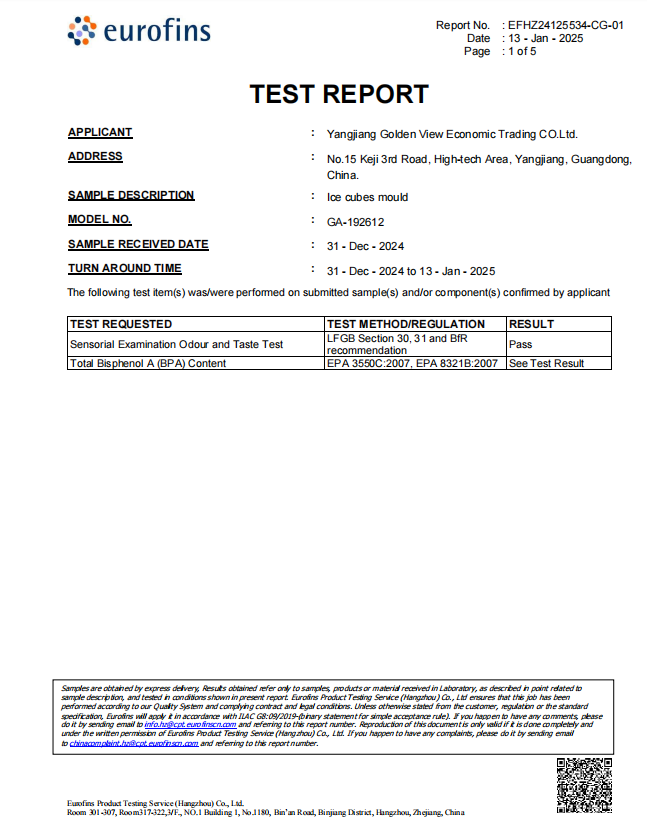
Yangjiang Golden View is a standout in the silicone ice mold category because it holds an actual third-party LFGB test report issued by Eurofins Product Testing Service (Report No. EFHZ24125534-CG-01, dated 13 Jan 2025). The tested product — an ice cubes mould (Model GA-192612) — passed the Sensorial Examination Odour and Taste Test under LFGB Section 30/31 and BfR recommendation, and was tested for Total Bisphenol A (BPA) Content per EPA 3550C:2007 and EPA 8321B:2007. With 13 years on Alibaba and FSC certification, Golden View combines verified compliance with export experience. For buyers targeting the EU and German markets specifically, this factory's documented LFGB compliance is a decisive advantage.
2.2 Yangjiang Sanyang Plastic Technology Co., Ltd.
Location: Yangjiang, Guangdong | Established: 2006 | Factory: 20,000 m², 300+ staff
Operating under the brand Sunova Living, Sanyang is one of the largest and most established silicone kitchenware manufacturers in Yangjiang — China's "knife and kitchenware capital." Its product line spans silicone ice cube trays, baby products, and kitchen gifts, with in-house R&D and design. The company emphasizes BPA-free, hygienic silicone and offers flexible OEM/ODM services. Its scale and vertical integration make it suitable for high-volume retail and private-label orders.
2.3 Dongguan Kerun Rubber Products Co., Ltd.
Location: Dongguan, Guangdong | Status: Diamond Member Audited Supplier (Made-in-China)
Dongguan is China's silicone rubber manufacturing heartland, and Kerun is a representative specialist. The factory produces silicone ice cube trays, chocolate molds, cake molds, and resin crafts, with a strong focus on precision molding and custom shapes. Its audited-supplier status and 5.0/5.0 service rating on Made-in-China signal consistent quality and on-time delivery. Kerun is a strong choice for buyers needing complex cavity designs or multi-material (silicone + plastic) ice mold sets.
2.4 Yuyao Shunyao Rubber Products Co., Ltd.
Location: Yuyao, Zhejiang | Key Certification: FDA & LFGB (declared)
Shunyao is a Zhejiang-based rubber and silicone specialist whose flagship silicone ice cube tray (Model SY6505) is explicitly marketed as FDA & LFGB compliant. The company offers star-shaped, round, and custom cavity designs at competitive price points (US$0.90–1.50 per unit at volume). Yuyao's proximity to the Port of Ningbo gives it a logistics advantage for export shipments. Buyers should request current third-party test reports to verify the declared certifications.
2.5 Zhongshan Xinyuan Silicone Rubber Co., Ltd.
Location: Zhongshan, Guangdong | Certification: ISO 9001:2015, Diamond Member Audited Supplier
Xinyuan specializes in reusable silicone ice cube trays with spill-resistant lids, targeting the premium home and bar segment. Its ISO 9001:2015 certification and audited-supplier status demonstrate structured quality management. The company offers low MOQs (from 50 pieces) and custom logo printing, making it suitable for small-batch brand launches and DTC sellers scaling toward mid-volume.
3. What Exactly Does LFGB Certification Test for Silicone Ice Molds?
LFGB is not a single checkbox — it is a comprehensive test battery. For silicone products, the governing standard is BfR Recommendation XV ("Silicones"), invoked under LFGB §30 (prohibition on harmful substance transfer) and §31 (market placement rules). The key tests are:
| Test | Standard/Method | Limit/Requirement | Why It Matters |
|---|---|---|---|
| Sensory Examination (Odor & Taste) | LFGB §30/31 + BfR XV | No perceptible odor or taste transfer vs. blank control | The single most common failure for cheap silicone; ensures ice is odorless and tasteless |
| Overall Migration (OML) | BfR XV / EN 1186 | ≤ 10 mg/dm² (or 60 mg/kg food) | Caps the total mass of all substances leaching into food |
| Specific Migration (SML) | BfR XV | Per-substance limits; cyclic siloxanes D4/D5/D6 restricted | Prevents endocrine-disrupting siloxanes from entering food |
| Volatile Organic Matter (VOM) | BfR XV | ≤ 0.5% (ref. method) | Controls residual monomers and low-molecular-weight compounds that cause odors |
| Organic Tin Compounds | BfR XV | Not detectable / strict limit | Tin catalysts are toxic; ensures proper curing |
| Peroxide Value | BfR XV | Within specified limit | Indicates oxidative degradation of the silicone matrix |
| BPA Content | EPA 3550C / EPA 8321B | BPA-free (ND) | Bisphenol A is an endocrine disruptor; banned in infant products |
The sensory test is what sets LFGB apart from basic FDA compliance. Under FDA 21 CFR 177.2600, silicone rubber compliance is largely based on formulation review and self-declaration — there is no mandatory third-party sensory or migration test. LFGB, by contrast, requires trained panelists to confirm that the material transfers zero detectable odor or taste. Any identifiable negative sensory change results in failure.
4. LFGB-Certified vs. Uncertified Factories: The Real Commercial Advantage
| Dimension | LFGB-Certified Factory (e.g., Yangjiang Golden View) | Uncertified Factory |
|---|---|---|
| Customs Clearance (EU) | DoC + test report on file; low detention risk | High risk of customs holds; product may be refused entry |
| Platform Compliance | Amazon, Temu, eBay accept LFGB reports for food-contact listing approval | Listing may be rejected or delisted mid-season |
| Recall Risk | Verified migration and sensory data; recall probability near zero | No data; a single odor complaint can trigger a full recall |
| Product Consistency | BfR XV-compliant raw materials and curing processes; no blooming | Peroxide-cured or filler-loaded silicone may bloom, discolor, or degrade |
| Brand Trust | "LFGB Certified" is a strong marketing claim, especially in DACH markets | No verifiable safety claim; price-only competition |
| Total Cost of Ownership | Slightly higher unit cost, but zero rework, zero returns, zero legal exposure | Lower unit price, but hidden costs from returns, recalls, and lost listings |
The data is clear: the LFGB-compliant silicone market is projected to grow at a CAGR of 8.7% from 2024 to 2030, reaching over $12.6 billion, as retailers and consumers increasingly demand verified food-safe materials.Who source from certified factories are aligning with this trend — and insulating themselves from the quality disasters that plague the uncertified segment.
5. Procurement Checklist: Vetting a Silicone Ice Mold Supplier
Before placing an order, demand these five things:
- A current third-party LFGB test report (ISO 17025 lab — Eurofins, SGS, TÜV, Intertek) covering sensory test, overall migration, and specific migration. Verify the report number directly with the lab.
- Material specification sheet confirming platinum-cured silicone (not peroxide-cured) and food-grade raw material sources.
- BPA-free declaration with supporting test data (EPA 3550C / 8321B or equivalent).
- Factory audit report (ISO 9001, BSCI, or equivalent) to verify quality management systems.
- Sample validation — run your own boil-and-freeze cycle test: boil the mold for 10 minutes, freeze water, and smell/taste the ice. Any chemical odor is an immediate red flag.
6. Conclusion
The silicone ice mold market is crowded, but not all factories are equal. Yangjiang Golden View leads on verified LFGB compliance — backed by a real Eurofins test report confirming sensory pass and BPA testing — while Sanyang, Kerun, Shunyao, and Xinyuan each bring scale, specialization, or flexibility to different buyer segments. The critical lesson for procurement partners is this: LFGB certification is not a marketing sticker. It is a rigorous test regime — sensory evaluation, overall migration ≤10 mg/dm², specific migration for cyclic siloxanes, VOM, organic tin, peroxide value, and BPA — that directly prevents the odor transfer, blooming, and excessive migration that cause product failures. Sourcing from an LFGB-certified factory may cost a few cents more per unit, but it eliminates the far larger costs of customs detention, platform delisting, recalls, and brand damage. In food-contact products, certification is the cheapest insurance you can buy.